 English
Skills you will learn include:
- Task analysis of learning problems
- Teaching strategies for exceptionalities
- The ability to gather and analyze data from curriculum-based measurement
- Assessment and evaluation procedures for students with cross-categorical disabilities
- Implementation of evidence-based practices and the ability to determine when and where to apply such practices
100% Content Assessment Pass Rate & 100% Graduate Placement Rate.
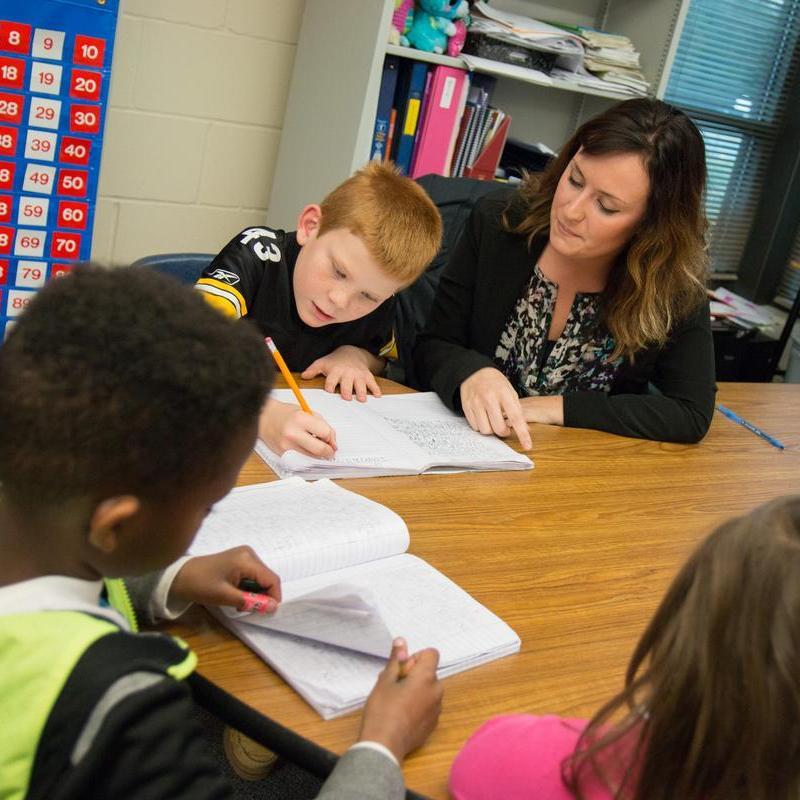
Within our special education program you will have the unique opportunity to work alongside seasoned professionals in the field and network with program administrators. Our small class sizes provide opportunity for you to receive individualized attention from your professors. Then you will take what you’ve learned in the classroom and apply it to the real world, gaining hands on experience through William Woods University offered clinical work and a semester of student teaching.
Our Special Education Certification at work
Using the knowledge and practicum they receive at William Woods University, bachelors in education graduates in special education are prepared to pursue an exciting career as:
- Special education teacher in private/public school system
- Emotional/behavioral classroom teacher
- Early intervention specialist
- Life skills teacher
- Learning support teacher
- Autism support teacher
Recent Employers
Our students are highly sought after by distinguished employers across the country, including:

“Special education has been my passion for quite some time. Having your professors share that same interest makes you even more passionate about it. I could not imagine going anywhere else and getting an education and life lessons that are so meaningful towards my future.”
— Taylor Oestreich, special education graduate
This degree program covers foundational knowledge in disabilities, legal mandates (like IDEA), and inclusive education practices. It includes courses on assessment, instructional strategies, behavior management, and using assistive technology to support diverse learners. Candidates gain hands-on experience through fieldwork and student teaching in various educational settings, including inclusive and self-contained classrooms. The program also emphasizes collaboration with families, specialists, and general education teachers to develop and implement effective, individualized education plans (IEPs).
Special Education Curriculum
Related Education Resources:
Major Requirements
Core Credits: 85.00
|
This course addresses various aspects of multiculturalism and cultural diversity such as culture, race, ethnicity, gender, class, religion, language, age, and exceptionality. By examining these micro-cultures, students will understand and use this knowledge to meet individual student needs and address cultural differences effectively in the classroom. Concepts and strategies for teaching different cultural, racial, and ethnic groups, including English language learners, are included. credits:
|
Multicultural Education -U | 3 |
credits:
|
Educational Technology | 3 |
|
A study of children with special needs who qualify for special education services. Topics include the history and legal basis of special education, the special education process, assessment and evaluation procedures, characteristics, and appropriate intervention strategies and teaching methods. Emphasis is placed on characteristics and teaching strategies for the following exceptionalities: learning disabilities, mental retardation, behavior/emotional disorders and giftedness. credits:
|
Exceptional Child | 3 |
|
This course is a comprehensive overview of the foundations of education in the United States. It focuses on the development of educational institutions and ideas, social forces that have influenced them and current issues affecting educators. It specifically includes a survey of the policies, procedures, portfolios and certification examinations that are part of the Missouri educator certification process. The nine Missouri Teacher Standards will be integrated, and used as a guide, throughout the course. credits:
|
Foundations of Education | 3 |
|
Instructional, classroom and student strategies involving mild/moderate cross categorical disabilities are provided. Readings, lectures, discussions and assignments focus on researched differentiated instruction. Prerequisite: EDU231 credits:
|
Cross Categorical Disabilities | 3 |
|
Teacher candidates observe and participate in an assigned classroom for a minimum of 30 hours. They observe and become familiar with the classroom organization and management, curriculum, and the school’s instructional program. They work with students in various groupings and observe and implement differentiation strategies. credits:
|
Beginning Clinical Experience | 2 |
|
Teacher candidates will study children’s literature and the content areas of language arts. They will create a unit plan which consists of 4 language arts lessons which are literature-based. The course includes units on language development, children’s literature, speaking, listening, spelling, grammar, punctuation, capitalization, penmanship, and interdisciplinary instruction. credits:
|
Teaching Language Arts & Children's Literature | 3 |
|
The focus of this course is on elementary social studies content knowledge and literacy, concepts, materials/resources, teaching strategies, methods, assessment of instruction, and using an integrated curriculum design for teaching elementary and middle grades students. Integration of the arts is included. Curricular guidelines and standards will follow the Missouri Learning Standards and national professional organizations such as the National Council for Social Studies credits:
|
Methods of Teaching Social Science | 3 |
|
The focus of this course is on elementary science content knowledge and literacy, concepts, materials/resources, teaching strategies, methods, assessment of instruction, and using an integrated curriculum design for teaching elementary and middle grades students. Integration of the arts is included. Curricular guidelines and standards will follow the Missouri Learning Standards and national professional organizations such as the National Science Teachers Association. credits:
|
Methods of Teaching Science | 3 |
|
This course is designed to provide undergraduate education students an opportunity to become familiar with selected content, appropriate instructional techniques, and materials for teaching mathematics. The philosophy of teaching mathematics recommended by the National Council of Teachers of Mathematics Curriculum Standards, Common Core State Standards, and Assessment Standards will be emphasized. In addition, Department of Elementary and Secondary Education Subject-Specific Competencies for Mathematics Education will also be addressed. credits:
|
Teaching Mathematics | 3 |
|
Language and communication disorders of students with special needs are investigated. Topics include normal language acquisition, language development of exceptional children, language problems and deficits, implications of language disorders and delays for learning, assessment, instructional strategies, and treatment. Prerequisite: EDU231 credits:
|
Language Development | 3 |
|
Teaching methods specific to remediation of special mathematics learning needs. Students will spend time in the schools assisting with the teaching of remedial mathematics. This course does not apply toward a major or minor in mathematics and does not apply toward the university’s Common Studies program. (Course prerequisite EDU 341 may be taken concurrently with EDU 353.) credits:
|
Teaching Remedial Mathematics | 3 |
|
Study of learning patterns, educational diagnostic techniques and development of educational strategies and materials for use with children with cross-categorical disabilities. This course requires 16 hours of clinical experience in the schools. Prerequisites: EDU 231, 258 credits:
|
Teaching Cross Categorical Disabilities | 3 |
|
This course addresses the special demands of content area reading and writing for both elementary and secondary students and encourages teachers in all content areas to reflect on their roles as literacy providers. An overview of the possible causes of reading difficulties and simple assessment procedures are discussed. Students will also learn teaching strategies for improved comprehension of content materials, study skills, and vocabulary. credits:
|
Reading & Wrtng in the Content Area | 3 |
|
Students will understand curriculum and instructional planning of reading and writing in k-12 classrooms. Students will plan and differentiate lessons based on student needs. Instruction will focus on reading, writing and language acquisition in all grade levels. Students will work together and experience different expectations for pre-service teachers in collaborative groups. Throughout this course students will develop a better understanding of literacy development; phonics, fluency, vocabulary, and comprehension. Students will understand how to organize literacy instruction credits:
|
Teaching Reading and Writing | 3 |
|
Teacher candidates observe and participate in various ways in an assigned classroom for a minimum of 45 hours. They become familiar with lesson planning, differentiation strategies, assessment techniques, and the analysis of demographic information. Teacher candidates work with students throughout this experience and plan and execute a lesson with the direction of the cooperating teacher. This lesson is delivered to the whole class, a small group, or an individual student. They then reflect on student learning as a result of this lesson. Prerequisite: EDU291 and Admittance to the Teacher Ed Program credits:
|
Intermediate Clinical Experience | 3 |
|
Addresses parental rights and responsibilities in the education of their child with special needs. Topics include the evaluation process, eligibility requirements and determination, the individualized education plan (IEP), and parent involvement in all stages of their child’s educational program. credits:
|
Conferencing and Consultation | 3 |
|
Individual diagnostic procedures are studied, including informal and formal assessment, the interpretation of assessment results, and development of educational programs and instruction. Proficiency in assessment procedures and test administration are emphasized. Prerequisites: EDU258 credits:
|
Measurement and Evaluation | 3 |
|
This is a field based course that covers instruction of language acquisition, phonics, fluency, comprehension and writing in a K-12 classroom. Students will observe a classroom during ELA instruction and tutor a student in reading and writing. Students will spend 12 hours intensively tutoring their assigned student, they will be assisted by collaborating during class meetings to better serve the student. The pre-service teacher will analyze reading and writing samples and assessments of their assigned student, they will then develop an appropriate lessons for language acquisition, phonics, vocabulary, and writing skills. Students will work intensively with students who have been assessed and need assistance to be at grade level in ELA instruction. Prerequisites: Entrance in the Teacher Education Program and EDU 395 credits:
|
Student Centered Reading & Writing | 3 |
|
The nature of behavior problems in schools, including types, etiology, and management through educational and behavioral intervention procedures are addressed. Students are encouraged to take this course the semester before they do their student teaching. Prerequisite: EDU231, EDU395 and Entrance into the TEP Program credits:
|
Classroom Management | 3 |
|
Learning characteristics, career/vocational opportunities, assessment of secondary students with mild to moderate disabilities are examined. Prerequisite: EDU258 and EDU358 credits:
|
Career/Vocational Education | 2 |
|
Teaching competence is strengthened through multiple means, including the examination of and reflection upon the students experiences during their supervised teaching placement. This is a writing intensive course that includes a community profile paper, reflection pieces and a culminating portfolio that documents performance standards. Class meetings occur before, during and after the student teaching experience. Prerequisite: Entrance into the Teacher Education Program and EDU 395 Corequisite: EDU 490 or EDU 493 or EDU 495 or EDU 499. credits:
|
Educational Seminar | 3 |
|
Teacher candidates are assigned to a specific special education classroom for 14 weeks. Using the co-teaching model, teacher candidates will work with a certified teacher to implement all elements of teaching (Missouri Teaching Standards). These elements of teaching will be phased in gradually, while continuing to use both teachers in the classroom to improve student learning. The teacher candidate will become the lead teacher as the semester progresses and will be responsible for all elements of teaching for a minimum of 6 weeks, under the guidance of the certified teacher. Teacher candidates will complete the MEES during the student teaching semester and will be supervised by a qualified university supervisor. Passing the MEES is required for MO teaching certification and successful completion of EDU 493. (Course Fee) Prerequisite: Entrance into the TEP program, EDU291 and EDU395 Corequisite: EDU 492 credits:
|
Supervised Teaching Special Education | 9 |
|
This course will address the mathematical knowledge, skill, and processes taught in K-8 classroom settings. The course will focus heavily on both the content and process standards developed by the National Council of Teachers of Mathematics and will use the six principles of mathematics as a guide. credits:
|
Understanding Mathematics for Tchrs | 3 |
|
To develop an understanding and competency in teaching health, nutrition, and safety in the elementary grades. Required for K-12 Physical Education, Early Childhood, and Elementary Education majors. credits:
|
Instrctnl Techniques in Health K-12 | 3 |
|
The study of the psychological principles that support the foundation of educational theory and practice. The student will be able to understand and apply the psychological principles that form the basis of educational theory and practice. credits:
|
Educational Psychology -Q | 3 |
|
The purpose of this course is to provide an overview of the typical development of a child from birth through emerging adulthood. Biological, cognitive and social development and the influencing factors will be covered. Students will be expected to apply the theories discussed in the course to improve child welfare. credits:
|
Child and Adolescent Development | 3 |