 English
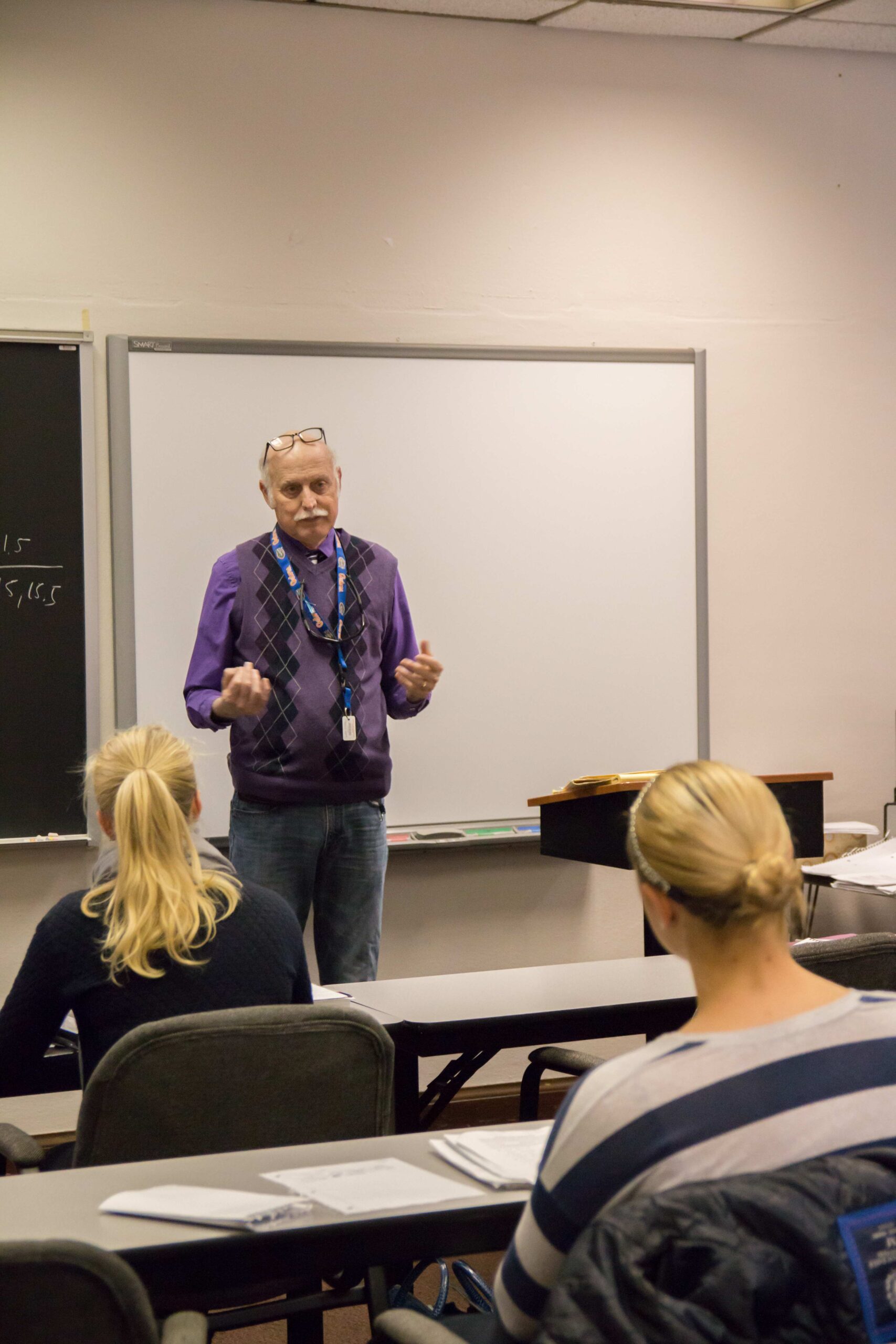
The minor in physics at William Woods University will prepare you with invaluable critical thinking skills and success in an incredibly diverse range of fields. It can strengthen your analytical and scientific skills to help you meet the demands of an increasingly technical society. Whether applying for graduate programs in science, developing a technical career or broadening your education, the physics minor provides a rewarding and challenging program of study that opens doors and gives you a greater understanding of the physical world.
The minor in physics at William Woods University includes 11 required course credits and 7 elective course credits.
Minor Requirements
Core Credits: 16.00
|
An introduction to the concepts of limits, continuity, differentiation of elementary functions, definite and indefinite integrals, and the Fundamental Theorem. Emphasis on use graphing calculators and the utility of mathematics as a problem solving tool. Extensive discussion of applications in natural science, social science, and business. Prerequisite: MAT 118 or MAT 120 credits:
|
Calculus I -Q | 5 |
|
An introductory physics course covering the topics of mechanics, thermodynamics, vibrations, and wave motion with an emphasis on critical thinking and problem solving. Computing software is used to provide interactive instruction and develop connections to the mathematical principals involved. Regular in-class demonstrations are performed and discussed in order to enhance conceptual understanding. Concurrent enrollment in PHY 202 required. (Lab Fee) credits:
|
Physics I -N | 4 |
|
The laboratory component of Physics I which reinforces and expands on concepts taught in the lecture. While conducting experiments, students will make observations about physical systems and collect numerical data. Emphasis is placed on identifying patterns and relationships in physical parameters. Students develop hypotheses in order to make predictions and verify presumptions. Formal lab reports are used to summarize relevant findings. Corequisite: PHY 201 credits:
|
Physics I Lab | 0 |
|
Includes laboratory exercises selected to reinforce and augment the physics lecture course that students earned credit for at a previous institution. Available only to students with posted transfer credit for PHY201 at time of enrollment. credits:
|
Physics I Lab for transfer students | 1 |
|
A continuation of the introductory physics sequence which covers topics in electrostatics, magnetism, optics, and modern physics. Fundamental concepts from Physics I are described in greater complexity. Students are expected to apply their understanding of energy, mass, force, and inertia to more advanced problems involving atomic systems. Demonstrations and computational simulations are used to increase conceptual understanding. Concurrent enrollment in PHY 213. (Lab Fee) Prerequisite: PHY 201. credits:
|
Physics II | 4 |
|
The laboratory component of Physics II which reinforces and expands on concepts taught in the lecture. Group experiments are conducted in order to analyze the behavior of physical systems. Emphasis is placed on interpretation and inference as students are expected to use knowledge from the previous course to explain physical phenomena. Computational interface equipment and graphing software are used extensively. Students design and construct their own experiment on two occasions. Corequisite: PHY 212 credits:
|
Physics II Lab | 0 |
|
An upper-division physics course exploring selected topics in contemporary physics, including: quantum physics, atoms, molecules, condensed matter, nuclei, relativity, and elementary particles. Prerequisite: PHY212 and PHY213 credits:
|
Modern Physics | 3 |
Required Elective - 4 Credits
|
A study of the fundamental principles and theories of chemistry with emphasis on stoichiometry and atomic theory and bonding. Must be taken concurrently with CHM115. Prerequisite -MAT099 or Math ACT/SAT of 22/520 or higher credits:
|
General Chemistry I -N | 4 |
|
Concurrent enrollment in CHM 114 required. Meets three hours per week. (Lab fee) credits:
|
General Chemistry I Lab | 0 |
|
Includes laboratory exercises selected to reinforce and augment the chemistry lecture course that students earned credit for at a previous institution. Available only to students with posted transfer credit for CHM114 at time of enrollment. (lab fee) credits:
|
General Chemistry I Lab transfer st | 1 |
|
A continuation of MAT 124. Further techniques of differentiation and integration, the calculus of exponential, logarithmic, trigonometric, and probability distribution functions, as well as elementary differential equations. Requires extensive use of graphing calculators. Applications to biology, economics, and physics are studied throughout. Prerequisite: MAT 124 credits:
|
Calculus II | 4 |