 English
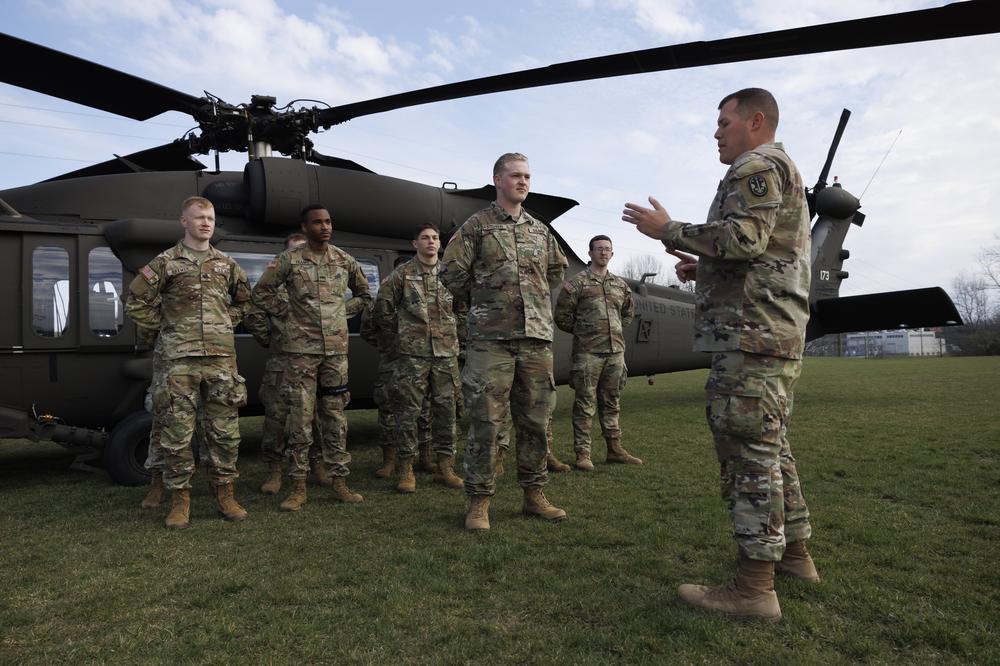
The Military Studies – GOLD minor provides graduates with a competitive advantage over their peers when seeking employment with government agencies and defense contractors through documented hands-on leadership experience. Graduates with the Military Studies – GOLD minor will be ready to assume leadership positions immediately upon graduation. The program provides focus on what students need to “Be, Know, and Do” in order to perform as effective leaders such as resolving conflict, decision-making, adapting to change, providing vision, motivating others, and achieving organizational goals. These are critical and necessary skills for every type of organization.
Minor Requirements
Core Credits: 12.00
|
Challenges students to study, practice, and evaluate adaptive leadership skills they are presented with the demands of preparing for Officer Candidate School and commissioning. Challenging scenarios related to small unit tactics are used to develop self-awareness and critical thinking skills. Students receive systematic and specific feedback on their leadership abilities. Primary attention is given to leadership values, attributes, skills, and actions. This course meets one of the requirements for the Leadership Studies Minor. Prerequisite: LDR201 or Experiential Learning credit (Previous or current National Guard, Reserve, or Active Duty military service may qualify for experiential learning). Corequisite: MIL311 credits:
|
Application of Military Leadership | 3 |
|
Classroom and field exercises designed around advanced military tactics and operations. Students will learn the Army Operations Order process, Troop Leading Procedures, land navigation, advanced leadership, the Army writing style, and physical training. Activities include field training exercises with other universities and leading students in offensive and defensive missions. Prerquisite: MIL301 Corequisite: MIL303 credits:
|
Advanced Military Leadership | 3 |
|
The lab will focus on scenarios designed around advanced military tactics and operations. Students will apply the information gained in MIL 302 to controlled military training scenarios. Corequisite: MIL302 credits:
|
Advanced Military Leadership Lab | 0 |
|
The lab will focus on scenarios designed around advanced military tactics and operations. Students will apply the information gained in MIL 301 to controlled military training scenarios. corequisite: MIL301 credits:
|
Application Military Leadership Lab | 0 |
|
Advanced training for contracted GOLD candidates. Successful completion of this course meets partial requirements for commission as an officer in the United States Army. Prerequisite: MIL301 & MIL302 or Experiential Learning credit (Current or previous National Guard, Reserve, or Active Duty may qualify for experiential learning) credits:
|
Officer Candidate School (OCS) I | 3 |
|
Advanced training for contracted GOLD candidates. Successful completion of this course meets partial requirements for commission as an officer in the United States Army. Prerequisite: MIL350 or Experiential Learning credit (Current or previous National Guard, Reserve, or Active Duty may qualify for experiential learning) credits:
|
Officer Candidate School (OCS) II | 3 |
Leadership Elective - 3 Credits
|
This course introduces students to a variety of leadership concepts and serves as a foundational course for more advanced study in leadership. Topics include but are not limited to motivating others, management communication, training and development, team building and improving leadership qualities within each person. credits:
|
Concepts in Leadership | 3 |
|
In this course, students will develop their ability to lead in complex, dynamic and often fast-changing environments. Students will analyze leadership as it is practiced and evaluate the personal dangers leaders often face when they practice leadership. This course is based on the research of Ronald Heifetz, Dean Williams and Marty Linsky. credits:
|
Adaptive Leadership | 3 |
|
The course will cover the principles needed to create and lead effective teams. Students will generate, compare and assess effective team interventions to produce high achieving teams in organizational settings. Topics covered in this course include stages of team development, identifying and assigning appropriate human capital to teams, team culture and alignment to corporate culture, ensuring team productivity through effective and timely leader interventions and team disbandment. credits:
|
Leading Teams | 3 |
|
An advanced level study that challenges students to investigate and analyze the attributes of effective global leadership. The United Nation’s (UN) Global Compact and its ten principles will be studied and used to measure globally responsible leadership and how good leadership impacts the issues facing global leaders today. Case studies will be used to illustrate each on the ten principles in actual contextual situations. The case studies allow the student the opportunity for thinking through the issues and seeing how leaders facing the same problems actually addressed them. credits:
|
Global Leadership | 3 |
|
This course emphasizes the importance of strategic leadership in the successful execution of strategic management processes within the firm. Students will assess and evaluate the strategic leader’s role in managing the firm’s resources and the strategic leader’s impact on firm performance. Strategic management concepts covered include competitive advantage, business strategy, corporate strategy, organizational design, and corporate governance. Prerequisite: LDR201 credits:
|
Strategic Leadership | 3 |
|
This course investigates the important role ethics plays in leading. In this course, students will develop an understanding of their own character development and its impact on followers as well as gaining insights into leading the self. Students will explore, analyze and investigate topics such as normative ethics’ role in leadership, servant and steward leadership, as well as sense making, satisficing and decision-making from an ethical leader perspective. credits:
|
Ethics in Leadership | 3 |
|
This course introduces student to leadership theory at an advanced level. Through the exploration, analysis and critique of such theories, students will develop a deeper understanding of leadership and leading. Topics covered in this course include but are not limited to historical perspectives of leadership, transformational and transactional leadership, charismatic leadership, dysfunctional leadership, power and political leadership. credits:
|
Leadership Theory | 3 |
History Elective - 3 Credits
|
The Great War had been fought as ”the war to end all wars,” and twenty years later British Prime Minister Neville Chamberlain still promised ”peace in our time.” But just six years later, nearly 80 million people were dead. Sparked by the rise of dictatorships, World War II was a clash of nations that represented a global conflict on a scale never before imagined. Exploring the perspectives of both the Allied and Axis powers, students will learn how the clash of ideologies and beliefs resulted in conquest, genocide, and, ultimately, liberation. Although traditionally understood as occurring from 1939–1945, this course will start from the war’s origins—beginning with the end of World War I through the rise of the Nazi Party to the Japanese invasion of China in 1937. Far from just a military history of war in Europe and the Pacific, this course will examine topics including: the Holocaust, ideologies (democracy, communism, fascism, anti-Semitism, racism, etc.), the A-bomb, world leaders (FDR, Truman, Churchill, Stalin, Hitler, Mussolini, Tojo, etc.), politics, propaganda, crime, the home front, and many more. Concluding with the Nuremberg and Tokyo War Crimes Trials and the start of the Cold War, the class will also examine the war’s legacy and aftermath. credits:
|
World War II | 3 |
|
An intensive study of the impact of two world wars on European society, politics, economics, culture, and diplomatic relations. credits:
|
From the Civil War to Civil Rights: the African-American Experience | 3 |