 English
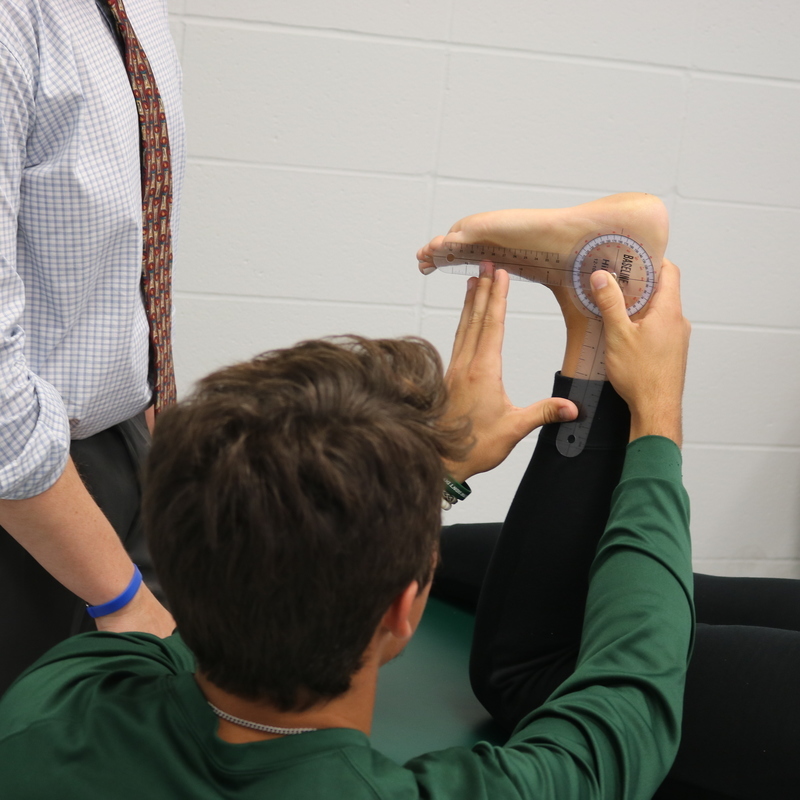
Concentrations and Curriculum
The Strength and Conditioning concentration is part of the Bachelor of Science in Exercise Science.
All Exercise Science students start with core set of classes that provide a solid foundation in health and wellness. Then students choose a concentration that aligns with their career goals and interests. In addition to Strength and Conditioning, concentrations include Pre-Athletic Training and Pre-Physical Therapy.
Major Requirements
Core Credits: 49.00
Foundational Sciences - 23 Credits
|
This introductory course will introduce students to basic nutrients, their functions, and the effects of various supply/demand states on physical well-being. Students will take a look at their own nutritional health and identify areas for improvement. Discussion will include the role of carbohydrates, fats, proteins, vitamins, minerals, and hydration on performance and optimal health. Prerequisite: EXS100 credits:
|
Introduction to Human Nutrition | 3 |
|
This course is designed around the American Red Cross Responding to Emergencies: Comprehensive First Aid/CPR/AED. In this course the student will be educated on proper Cardiopulmonary Resuscitation for the adult, child and infant. Also, the student will be taught how to identify and care for several sudden illnesses, as well as, proper First Aid techniques and procedures for bodily injuries ranging from minor bleeding to severe musculoskeletal conditions. Upon completion of this course, proper demonstration of skills, and meeting American Red Cross guidelines the student will receive American Red Cross certification in CPR/AED for Adult, Child, and Infant, as well as certification in First Aid. This certification will last for two (2) years. Physical Requirements: The student will also have to perform several skills that will require them to be in a crouched, kneeling, or squatted position for a minimum of five (5) minutes. credits:
|
First Aid and CPR | 2 |
|
This course will provide the learner with an overview of the gross anatomy of the human body. The course covers the anatomy of the integumentary, skeletal, muscular, cardiovascular, pulmonary, endocrine, digestive, and reproductive systems. To prepare the learner for progression through the Exercise Science sequence, an emphasis in the course will be placed on musculoskeletal anatomy including hands-on labs Corequisite: EXS206 credits:
|
Intro to Human Anatomy | 4 |
|
Lab class taken in conjunction with EXS 205 Intro to Human Anatomy Corequisite: EXS205 credits:
|
Intro to Human Anatomy Lab | 0 |
|
This course is designed to provide the learner an overview of the function of the human body. The course covers the physiology of the integumentary, musculoskeletal, neuro-endocrine, cardiopulmonary, digestive, and urinary-reproductive systems. This course will place an emphasis on musculoskeletal and cardiopulmonary adaptations to exercise. Prerequisite: EXS205 Corequisite: EXS246 credits:
|
Introduction to Exercise Physiology | 4 |
|
Lab class taken in conjunction with EXS 245 Intro to Human Physiology Prerequisite: EXS205 Corequisite: EXS245 credits:
|
Intro to Human Physiology Lab | 0 |
|
Prevention and care of athletic injuries is essential for any future professional working with active people and athletes. Coursework is designed to assess status and at-risk individuals, enhance the safety of activity and competition, and care for injury and illness within their future scope of practice Prerequisite: EXS104 and (EXS123 or EXS245) Corequisite:EXS304 credits:
|
Prevention and Care Athletic Injuries | 3 |
|
Lab class taken in conjunction with EXS 303 – Prevention & Care of Athletic Injuries. Hands-on learning in basic athletic training techniques. Prerequisite: EXS104 and EXS245 Corequisite:EXS303 credits:
|
Prevention and Care Lab | 1 |
|
Students will develop a deeper understanding of human anatomy, physiology, and biomechanics as it relates to exercise and sport. This course will help students analyze movement, identify muscle activity, and learn strategies for improving or maintaining muscular strength, endurance, flexibility and overall health. Students will build a foundation of understanding and apply methods for maximizing movement from head to toe. Prerequisite: EXS 205 credits:
|
Kinesiology | 3 |
|
This course will review basic human anatomy and physiology while advancing the learner’s understanding of the body’s adaptations to aerobic and anaerobic training as well as environmental factors. Prerequisite: EXS123 or EXS245 credits:
|
Exercise Physiology | 3 |
Applied Sciences - 26 Credits
|
Students will gain an appreciation and understanding of the human body’s response to resistance and conditioning exercises, learn proper technique and safety precautions through lecture and laboratory experiences. Students can obtain a certificate in Foundations of Coaching Lifts through the National Strength and Conditioning Association upon completion of essential coursework and skills demonstration Prereqisite: EXS205 Corequisite:EXS342 credits:
|
Techniques of Resistance Training and Conditioning | 3 |
|
Students will gain an appreciation and understanding of the human body’s response to resistance and conditioning exercises, learn proper technique and safety precautions through lecture and laboratory experiences. Students can obtain a certificate in Foundations of Coaching Lifts through the National Strength and Conditioning Association upon completion of essential coursework and skills demonstration. Prerquisite: EXS205 credits:
|
Techniques of Resistance Training and Conditioning – Lab | 1 |
|
This course will provide the learner with proper methods for selecting and performing exercise testing. Exercise testing will also address client safety including modifications for special populations. After performing exercise testing, the will learner will be introduced to prescribing exercise to varying populations based on testing results. Prerequisite: EXS322 Corequisite: EXS366 credits:
|
Exercise Testing and Prescription | 4 |
|
Lab class taken in conjunction with EXS 365 Exercise Testing and Prescription Prerequisite: EXS322 Corequisite: EXS365 credits:
|
Exercise Testing and Prescription Lab | 0 |
|
This course introduces concepts related to creating and maintaining a strength and conditioning facility and establishing facility policies and procedures. The learner will also learn concepts of business administration including legal and ethical practices related human resources and marketing. The course will also address oversight of assessment and strength and conditioning programs. Prerequisite: EXS241 credits:
|
Administration in Strength & Conditioning | 3 |
|
Course requires a minimum of 150 clock hours in an approved work situation. The student must submit a log documenting the work dates and times and describing the work activities according to at least three pre-approved objectives. In addition, the student will submit three essays describing and evaluating each of the following: the role of the on-site supervisor, the quality of the work environment, and the usefulness of extended internship activities. The student will also prepare a resume. Requires permission of the instructors and the internship supervisor Prerequisite:EXS104 and EXS241 credits:
|
EXS Internship I | 3 |
|
This course will review principles of exercise physiology and exercise testing then introduce the learner to the concept of periodization to maximize client performance through in-season and off-season training. Prerequisite: EXS365 credits:
|
Exercise Program Design | 3 |
|
This course will serve as the capstone for the Exercise Science program. Learners will be immersed in multiple, hands on opportunities to learn the value of performance data, how to collect and analyze the data, and how to make recommendations to improve programs based on its findings. Students will demonstrate knowledge of basic statistical analyses. Students will also analyze and present research projects in three formats: written manuscript, oral presentation, and poster presentation. credits:
|
Research in Sport Science | 3 |
|
Course requires a minimum of 150 clock hours in an approved work situation. In addition submitting a log of work activities with dates and times, the student will develop a complete portfolio documenting internship activities and outcomes, with brief explanatory texts. The student will also prepare a resume. Requires permission of the instructor and the internship supervisor Prerequisite: EXS390 credits:
|
EXS Internship II | 3 |
|
This course will review anatomy, physiology, biomechanics, nutrition, exercise physiology, and sport psychology to prepare the learner to sit for the National Strength & Conditioning Association’s Certified Strength & Conditioning Specialist (CSCS) certification examination. This course will help the future strength and conditioning professional transition to the profession through professional development opportunities, public speaking, and evidence-based practice. Course Fee: $475 (CSCS exam registration fee) Prerequisites: EXS405 credits:
|
Principles of Strength & Conditioning | 3 |
Concentrations
Pre-Physical Therapy Concentration - 45-48 Credits
Required Credits: 45.00
|
This course will introduce the broad underpinnings of biological science with a focus on the subcellular level. Students will be expected to describe fundamental molecular topics – such as water, DNA, and shape – and begin integrating them in the context of overarching principles such as scientific method, biological systems, and evolution. This course is geared toward science majors and pre-health professions students. Concurrent enrollment in BIO115 required. credits:
|
Biology I for Majors -N | 4 |
|
The purpose of this lab is to offer a hands-on investigative experience with some of the content addressed in BIO 114. Topics include measurement and microscopy, structure and function of the cell, the fundamental chemistry of life, photosynthesis, cellular respiration, Mendelian genetics, and an introduction to molecular biology. Experimental design, use of scientific equipment, and critical thinking are emphasized, culminating in the execution and analysis of a student-designed experiment during the second half of the course. Concurrent enrollment in BIO 114 required. credits:
|
Biology I Lab for Majors | 0 |
|
Students conduct laboratory exercises selected to reinforce and augment the biology lecture course that students earned credit for at a previous institution. Experiments illustrate basic life principles and structures. Available only to students with posted transfer credit for BIO114 at time of enrollment. (Lab fee) credits:
|
Gen Bio I Lab for Transfer students | 1 |
|
A continuation of the introductory sequence in biology, emphasizing the diversity of life as illustrated by organisms in the five major divisions of life forms. Anatomical, morphological, and life cycle characteristics of the various phyla and classes are introduced, and evolutionary and functional relationships stressed. Concurrent enrollment is BIO 125 required. credits:
|
Biology II for Majors | 4 |
|
This laboratory primarily surveys the organisms of the major divisions of life forms, and visually demonstrates the changes in complexity of their form and structure as evolutionary processes have shaped organisms through geological time. Concurrent enrollment in BIO 124 required. Required Lab fee credits:
|
Biology II Lab for Majors | 0 |
|
This course is a study of the mammalian nervous system, with special emphasis on the human brain. This course covers the fundamentals of 1. The structure and function of the neuron, including action potentials, neurotransmitter, and the effects of hormones and drugs on the brain, 2. The organization and function of neural systems including basic neuroanatomy, the senses, and motor movement, and 3. Brain behavior interactions including learning and memory, attention, sleep, and emotions. Prerequisite: BIO231/232 credits:
|
Neuroscience | 3 |
|
This course covers the biological mechanisms of immunity and disease, including hereditary diseases, infectious diseases, and cancer. Human disorders and diseases of the cardiovascular, respiratory, gastrointestinal, urinary, reproductive, endocrine, nervous, musculoskeletal, and integumentary systems are investigated, along with mental disorders and diseases of the sensory organs. The importance of animal models in disease will be emphasized. This course will also cover the basics of bioethics and modern pathophysiological methods. Prerequisite: BIO231/232 or EXS205/206 credits:
|
Human Diseases; Modern Understanding of Pathophysiology | 3 |
|
A study of the fundamental principles and theories of chemistry with emphasis on stoichiometry and atomic theory and bonding. Must be taken concurrently with CHM115. Prerequisite -MAT099 or Math ACT/SAT of 22/520 or higher credits:
|
General Chemistry I -N | 4 |
|
Concurrent enrollment in CHM 114 required. Meets three hours per week. (Lab fee) credits:
|
General Chemistry I Lab | 0 |
|
Includes laboratory exercises selected to reinforce and augment the chemistry lecture course that students earned credit for at a previous institution. Available only to students with posted transfer credit for CHM114 at time of enrollment. (lab fee) credits:
|
General Chemistry I Lab transfer st | 1 |
|
A continuation of CHM 114 with emphasis on equilibrium, electrochemistry, kinetics, and thermodynamics. Prerequisites:CHM 114 and CHM 115 credits:
|
General Chemistry II | 4 |
|
A laboratory study of principles of equilibrium and inorganic reactions directed toward the qualitative analysis of inorganic materials. Concurrent enrollment in CHM 124 required. (Lab fee) Prerequisites: CHM 114 and CHM 115 credits:
|
General Chemistry II Lab | 0 |
|
This course is designed for students seeking a graduate degree in health sciences. The course will address pre-requisite coursework, application processes, scopes of practice, areas of practice, and continuing professional education. Students will also be required to complete observation hours with a licensed healthcare provider (AT, DC, OT, PT, etc). credits:
|
Introduction to Health Professions | 3 |
|
This course provides an introduction to medical terminology and its application in interdisciplinary settings. Students will become familiar with medical terms used to define body systems and the importance of proper use of these terms. This course is geared towards pre-health professions students and those degrees that will interact with health professionals. credits:
|
Introduction to Medical Terminology | 3 |
|
An introductory course in statistics. Topics include: elementary probability, measures of central tendency and variation, normal distributions, sampling, confidence intervals, estimation, hypothesis testing, regression and correlation. Emphasis on the use of graphing calculators and the utility of mathematics as a problem-solving tool. Extensive discussion of applications in natural science, social science, and business. Prerequisite: MAT 099 or equivalent. credits:
|
Elementary Statistics -M | 3 |
|
An introductory physics course covering the topics of mechanics, thermodynamics, vibrations, and wave motion with an emphasis on critical thinking and problem solving. Computing software is used to provide interactive instruction and develop connections to the mathematical principals involved. Regular in-class demonstrations are performed and discussed in order to enhance conceptual understanding. Concurrent enrollment in PHY 202 required. (Lab Fee) credits:
|
Physics I -N | 4 |
|
The laboratory component of Physics I which reinforces and expands on concepts taught in the lecture. While conducting experiments, students will make observations about physical systems and collect numerical data. Emphasis is placed on identifying patterns and relationships in physical parameters. Students develop hypotheses in order to make predictions and verify presumptions. Formal lab reports are used to summarize relevant findings. Corequisite: PHY 201 credits:
|
Physics I Lab | 0 |
|
Includes laboratory exercises selected to reinforce and augment the physics lecture course that students earned credit for at a previous institution. Available only to students with posted transfer credit for PHY201 at time of enrollment. credits:
|
Physics I Lab for transfer students | 1 |
|
A continuation of the introductory physics sequence which covers topics in electrostatics, magnetism, optics, and modern physics. Fundamental concepts from Physics I are described in greater complexity. Students are expected to apply their understanding of energy, mass, force, and inertia to more advanced problems involving atomic systems. Demonstrations and computational simulations are used to increase conceptual understanding. Concurrent enrollment in PHY 213. (Lab Fee) Prerequisite: PHY 201. credits:
|
Physics II | 4 |
|
The laboratory component of Physics II which reinforces and expands on concepts taught in the lecture. Group experiments are conducted in order to analyze the behavior of physical systems. Emphasis is placed on interpretation and inference as students are expected to use knowledge from the previous course to explain physical phenomena. Computational interface equipment and graphing software are used extensively. Students design and construct their own experiment on two occasions. Corequisite: PHY 212 credits:
|
Physics II Lab | 0 |
|
An introduction to psychology as a scientific discipline surveying interpersonal behavior, personality development, intelligence, psychopathology, assessment, treatment, and research methodology. credits:
|
General Psychology II -Q | 3 |
|
The purpose of this course is to provide an overview of the typical development of a child from birth through emerging adulthood. Biological, cognitive and social development and the influencing factors will be covered. Students will be expected to apply the theories discussed in the course to improve child welfare. credits:
|
Child and Adolescent Development | 3 |
Abnormal Psychology Elective - 3 credits, if needed
|
The study of the factors which lead an individual to pathological behavior, the types of abnormal behavior, and the current methods of therapy. Prerequisite – PSY102 or PSY105 credits:
|
Abnormal Psychology | 3 |
Strength and Conditioning Concentration - 9 Credits
Required Credits: 9.00
|
Sports nutrition is a broad term used to describe the study of optimal ingestion practices to improve exercise and/ or sports performance. Students will take a scientific look at macronutrients, supplementation, nutrient timing, hydration, and more to enhance training for various types of athletes and fitness enthusiasts. Prerequisite: EXS103 credits:
|
Advanced Human Nutrition | 3 |
|
This course will provide the learner with the knowledge of the developmental stages of the neuromuscular system to allow for movement acquisition, how children learn and control new movements, and how this relationship leads to motor planning over a lifespan. Learners will be engaged in hands on learning in which students will be able to blend theory with practice in real life situations. Prerequisite:EXS321 credits:
|
Motor Learning and Development | 3 |
|
An introduction to the theoretical concepts and current research in the psychology of sport and exercise. credits:
|
Sports Psychology | 3 |
Pre-Athletic Training Concentration - 36 Credits
Required Credits: 36.00
|
This course will introduce the broad underpinnings of biological science with a focus on the subcellular level. Students will be expected to describe fundamental molecular topics – such as water, DNA, and shape – and begin integrating them in the context of overarching principles such as scientific method, biological systems, and evolution. This course is geared toward science majors and pre-health professions students. Concurrent enrollment in BIO115 required. credits:
|
Biology I for Majors -N | 4 |
|
The purpose of this lab is to offer a hands-on investigative experience with some of the content addressed in BIO 114. Topics include measurement and microscopy, structure and function of the cell, the fundamental chemistry of life, photosynthesis, cellular respiration, Mendelian genetics, and an introduction to molecular biology. Experimental design, use of scientific equipment, and critical thinking are emphasized, culminating in the execution and analysis of a student-designed experiment during the second half of the course. Concurrent enrollment in BIO 114 required. credits:
|
Biology I Lab for Majors | 0 |
|
Students conduct laboratory exercises selected to reinforce and augment the biology lecture course that students earned credit for at a previous institution. Experiments illustrate basic life principles and structures. Available only to students with posted transfer credit for BIO114 at time of enrollment. (Lab fee) credits:
|
Gen Bio I Lab for Transfer students | 1 |
|
This course is a study of the mammalian nervous system, with special emphasis on the human brain. This course covers the fundamentals of 1. The structure and function of the neuron, including action potentials, neurotransmitter, and the effects of hormones and drugs on the brain, 2. The organization and function of neural systems including basic neuroanatomy, the senses, and motor movement, and 3. Brain behavior interactions including learning and memory, attention, sleep, and emotions. Prerequisite: BIO231/232 credits:
|
Neuroscience | 3 |
|
This course covers the biological mechanisms of immunity and disease, including hereditary diseases, infectious diseases, and cancer. Human disorders and diseases of the cardiovascular, respiratory, gastrointestinal, urinary, reproductive, endocrine, nervous, musculoskeletal, and integumentary systems are investigated, along with mental disorders and diseases of the sensory organs. The importance of animal models in disease will be emphasized. This course will also cover the basics of bioethics and modern pathophysiological methods. Prerequisite: BIO231/232 or EXS205/206 credits:
|
Human Diseases; Modern Understanding of Pathophysiology | 3 |
|
A study of the fundamental principles and theories of chemistry with emphasis on stoichiometry and atomic theory and bonding. Must be taken concurrently with CHM115. Prerequisite -MAT099 or Math ACT/SAT of 22/520 or higher credits:
|
General Chemistry I -N | 4 |
|
Concurrent enrollment in CHM 114 required. Meets three hours per week. (Lab fee) credits:
|
General Chemistry I Lab | 0 |
|
Includes laboratory exercises selected to reinforce and augment the chemistry lecture course that students earned credit for at a previous institution. Available only to students with posted transfer credit for CHM114 at time of enrollment. (lab fee) credits:
|
General Chemistry I Lab transfer st | 1 |
|
Sports nutrition is a broad term used to describe the study of optimal ingestion practices to improve exercise and/ or sports performance. Students will take a scientific look at macronutrients, supplementation, nutrient timing, hydration, and more to enhance training for various types of athletes and fitness enthusiasts. Prerequisite: EXS103 credits:
|
Advanced Human Nutrition | 3 |
|
An introduction to the theoretical concepts and current research in the psychology of sport and exercise. credits:
|
Sports Psychology | 3 |
|
This course is designed for students seeking a graduate degree in health sciences. The course will address pre-requisite coursework, application processes, scopes of practice, areas of practice, and continuing professional education. Students will also be required to complete observation hours with a licensed healthcare provider (AT, DC, OT, PT, etc). credits:
|
Introduction to Health Professions | 3 |
|
This course provides an introduction to medical terminology and its application in interdisciplinary settings. Students will become familiar with medical terms used to define body systems and the importance of proper use of these terms. This course is geared towards pre-health professions students and those degrees that will interact with health professionals. credits:
|
Introduction to Medical Terminology | 3 |
|
An introductory course in statistics. Topics include: elementary probability, measures of central tendency and variation, normal distributions, sampling, confidence intervals, estimation, hypothesis testing, regression and correlation. Emphasis on the use of graphing calculators and the utility of mathematics as a problem-solving tool. Extensive discussion of applications in natural science, social science, and business. Prerequisite: MAT 099 or equivalent. credits:
|
Elementary Statistics -M | 3 |
|
An introductory physics course covering the topics of mechanics, thermodynamics, vibrations, and wave motion with an emphasis on critical thinking and problem solving. Computing software is used to provide interactive instruction and develop connections to the mathematical principals involved. Regular in-class demonstrations are performed and discussed in order to enhance conceptual understanding. Concurrent enrollment in PHY 202 required. (Lab Fee) credits:
|
Physics I -N | 4 |
|
The laboratory component of Physics I which reinforces and expands on concepts taught in the lecture. While conducting experiments, students will make observations about physical systems and collect numerical data. Emphasis is placed on identifying patterns and relationships in physical parameters. Students develop hypotheses in order to make predictions and verify presumptions. Formal lab reports are used to summarize relevant findings. Corequisite: PHY 201 credits:
|
Physics I Lab | 0 |
|
Includes laboratory exercises selected to reinforce and augment the physics lecture course that students earned credit for at a previous institution. Available only to students with posted transfer credit for PHY201 at time of enrollment. credits:
|
Physics I Lab for transfer students | 1 |
|
An introduction to psychology as a scientific discipline surveying the biological basis of behavior, motivation, learning, sensation, perception, memory, thinking and language. credits:
|
General Psychology I -U | 3 |