 English
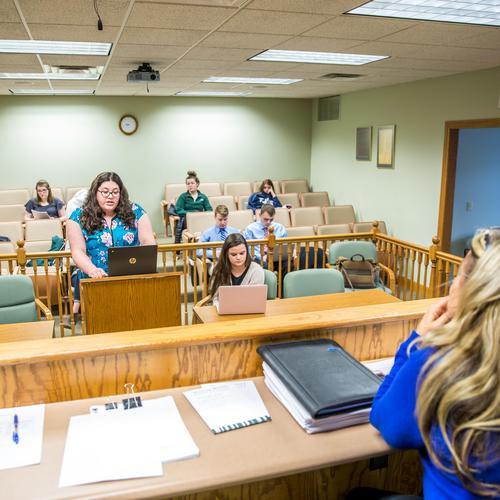
Whether you’re preparing for a career in law enforcement, industrial and homeland security, law, social work, corrections, or the judicial system, or you simply want to gain a better understanding of today’s justice landscape, you can benefit from a minor in criminal justice. It can serve as a useful supplement to a bachelor’s degree in legal studies, English, education and more.
The minor in criminal justice at William Woods University includes 18 course credits total — 9 required course credits and 9 required elective credits.
Minor Requirements
Core Credits: 9.00
|
This introductory course will examine crime in America with a focus on the role of police, courts, and correctional institutions. Students will consider the balance between freedom and security issues and evaluate the strengths and weaknesses of the American justice system as it adapts to cultural, political, and societal changes. credits:
|
Introduction to Criminal Justice | 3 |
|
This introductory course will explore the cause and major theories of criminal behavior. Students will learn the various research techniques that have been used to study criminal behavior and examine connections to social, environmental and ethnographical factors. Students will gain a more complete understanding of crime and how it relates to human social life. Finally students will apply the knowledge gained in their studies to examine current policy trends and the methods used to address crime and proscribed social behavior. credits:
|
Criminology -Q | 3 |
|
This course involves the study of substantive and procedural criminal law including due process, probable cause, statutory and case law authorities governing criminal law and rules of criminal procedure. This course will also provide a foundation for further work in the Criminal Justice field, and host an in-depth examination of the crimes committed by suspects, and actions taken by criminal justice professionals to deal with those crimes. credits:
|
Criminal Law | 3 |
Required Upper Level CMJ Elective - 9 Credits
credits:
|
Independent Study | 3 |
|
This course is about policing at its most important and challenging levels–in neighborhoods and communities across the nation and abroad. We will discuss community policing, problem solving, COPPS, control and prevention of crime, disorder and fear. We will also examine daily processes and tactics, how and why agencies are revolutionizing their traditional philosophy and operations, policing in an information age, and how the economy is impacting policing practices and new information concerning COPPs initiatives across the United States. credits:
|
Community Policing | 3 |
|
This course will examine the history and status of domestic and international terrorism. We will emphasize different regions of the world and the terrorist groups in each region. As well as examine terrorist events, groups, responses to terrorism, changes in terrorist strategies, and current and future trends. credits:
|
Foreign and Domestic Terrorism | 3 |
|
In this course we will explore the theoretical and practical aspects of mapping for criminal justice purposes. Students will gain a solid understanding of the empirical realities of the spatial aspects of crime, uses of GIS, the geography of crime and practical instruction and exercises on how to use GIS to conduct crime mapping and spatial analysis. credits:
|
Crime Mapping | 3 |
|
This is an introductory course which examines the many facets of Crime Scene Investigation, with a strong emphasis on homicide investigations, to include: the processing of a crime scene, the collection, preservation, and collation of forensic evidence, the post mortem examinations of homicide victims, the development of detective leads in searching for suspects, as well as the many law enforcement sub-disciplines associated with scientific forensic examination. This course will examine these modules concurrently with a comprehensive examination of a real-life, unsolved, serial killer cold case, to provide real-world context to the related concepts. credits:
|
Crime Scene Investigation | 3 |
|
This course will place a heavy emphasis on the cultural, social, economic, and carceral consequences of US drug policy formation as well as the enforcement of these laws by governmental agencies. It will also place an emphasis on public and personal perceptions which impact our understandings, and misunderstandings, of what constitutes ‘drug use’, who a ‘drug user’ is, and what ‘drug use’ means to various US sub-populations. In addition, it will provide a history of US illicit drug use, with an emphasis on cultural socio-demographics, and how immigration policy has influenced our current legal system as it related to illicit substances. credits:
|
Drugs in America | 3 |
|
In this course we will discuss contemporary research methods applied to criminal justice and criminology. We will demonstrate how research is relevant to the field and what tools are needed to actually conduct that research. We will examine qualitative research and quantitative research and discuss real-life examples and explain how to competently critique as well as create research-based knowledge. credits:
|
Research Mthds in Criminal Justice | 3 |
|
This course will examine digital forensics as it relates to both civil and criminal investigations. Topics include best practices in securing, processing, acquiring, examining and reporting on digital evidence as well as an examination of software programs such as Encase™, which is often used in digital investigations. credits:
|
Digital Evidence and Forensic Investigations | 3 |
|
Focuses on critical issues in criminal justice. May encompass topics related to law, law enforcement, the courts, corrections, etc. Specific issues are determined by the instructor. credits:
|
Special Topics: Criminal Justice | 3 |
|
This course will cover all aspects of transportation security as it relates to air, maritime, railroad, trucking, mass transit, and pipeline security. We will discuss global threats, new technologies, the need for adequate transportation security and how to implement basic master security plans. credits:
|
Transportation and Cargo Security | 3 |
|
Issues addressed in this course include descriptions of the types of crimes and terrorist acts committed using computer technology, theories addressing hackers and other types of digital criminals, an overview of the legal strategies and tactics targeting this type of crime, and in-depth coverage of investigating and researching digital crime, digital terrorism, and information warfare. Additionally, upon completion of the course, students should find themselves better prepared for further study into the growing problems of crime, terrorism and information warfare being committed using computer technology. credits:
|
Cybercrime and Information Warfare | 3 |
credits:
|
Information Security | 3 |
|
Field experience in criminal justice will be offered in this internship. Placements may include LETI, local & state police agencies, district attorney’s offices and corporate security and safety departments. Prerequisite: Requires permission of the instructor and the division chair. credits:
|
CMJ Internship I | 3 |
|
Field experience in criminal justice will be offered in this internship. Placements may include LETI, local & state police agencies, district attorney’s offices and corporate security and safety departments. Prerequisite: Requires permission of the instructor and the division chair. credits:
|
CMJ Internship | 6 |
|
This course will discuss the field of industrial/private security. We will explore security operations management, vulnerability assessments, physic security systems, disaster recovery, retail loss, investigations and workplace violence. credits:
|
Security Management | 3 |
credits:
|
Senior Seminar | 3 |