 English
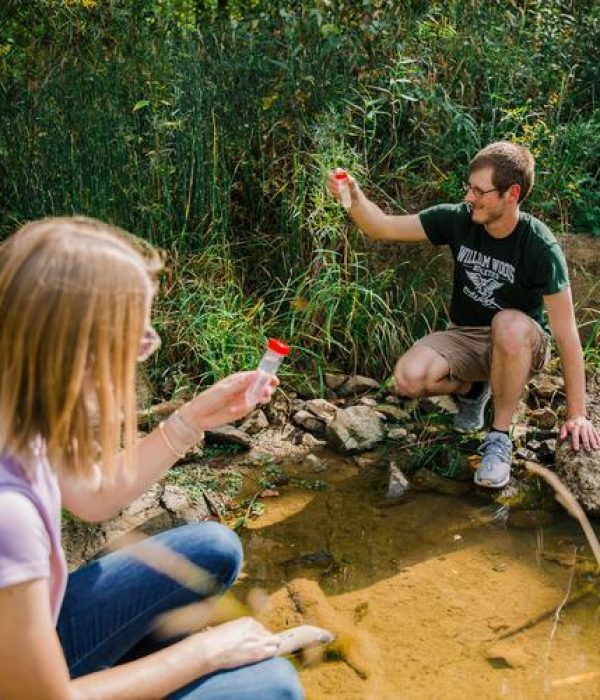
A strong foundation in the science of life can benefit a multitude of careers. Aspiring Exercise science major interested in Physical Therapy school? Perhaps you simply want a better understanding of life on Earth.
The minor in biology at William Woods University includes 18 required course credits.
Minor Requirements
Core Credits: 12.00
|
This course will introduce the broad underpinnings of biological science with a focus on the subcellular level. Students will be expected to describe fundamental molecular topics – such as water, DNA, and shape – and begin integrating them in the context of overarching principles such as scientific method, biological systems, and evolution. This course is geared toward science majors and pre-health professions students. Concurrent enrollment in BIO115 required. credits:
|
Biology I for Majors -N | 4 |
|
The purpose of this lab is to offer a hands-on investigative experience with some of the content addressed in BIO 114. Topics include measurement and microscopy, structure and function of the cell, the fundamental chemistry of life, photosynthesis, cellular respiration, Mendelian genetics, and an introduction to molecular biology. Experimental design, use of scientific equipment, and critical thinking are emphasized, culminating in the execution and analysis of a student-designed experiment during the second half of the course. Concurrent enrollment in BIO 114 required. credits:
|
Biology I Lab for Majors | 0 |
|
Students conduct laboratory exercises selected to reinforce and augment the biology lecture course that students earned credit for at a previous institution. Experiments illustrate basic life principles and structures. Available only to students with posted transfer credit for BIO114 at time of enrollment. (Lab fee) credits:
|
Gen Bio I Lab for Transfer students | 1 |
|
A continuation of the introductory sequence in biology, emphasizing the diversity of life as illustrated by organisms in the five major divisions of life forms. Anatomical, morphological, and life cycle characteristics of the various phyla and classes are introduced, and evolutionary and functional relationships stressed. Concurrent enrollment is BIO 125 required. credits:
|
Biology II for Majors | 4 |
|
This laboratory primarily surveys the organisms of the major divisions of life forms, and visually demonstrates the changes in complexity of their form and structure as evolutionary processes have shaped organisms through geological time. Concurrent enrollment in BIO 124 required. Required Lab fee credits:
|
Biology II Lab for Majors | 0 |
|
This course will emphasize current developments and techniques in the study of inheritance including extensions and applications of transmission, population, and molecular genetics. Laboratory experiences will include Mendelian crosses of model organisms, computer simulations via software and Internet of traditional and population genetics, and an introduction to cell-molecular genetics techniques including micropipetting, sterile bacterial culture, and visualization and mapping of DNA via gel electrophoresis. Thought processes and problem solving will be emphasized. Concurrent enrollment in BIO 232 required. Prerequisites: BIO114/115 and BIO124/125 (*MAT 118 should be completed prior to or concurrent enrollment with BIO231/232) credits:
|
Genetics | 4 |
|
Laboratory experiences will include Mendelian crosses of model organisms, computer simulations via software and Internet of traditional and population genetics, and an introduction to molecular genetics techniques including micropipetting, sterile bacterial culture, and visualization and mapping of DNA via gel electrophoresis. Concurrent enrollment in BIO 231 required. Required Lab fee credits:
|
Genetics Lab | 0 |
Upper Level Electives - 8 Credits
credits:
|
Independent Study | 3 |
|
This course serves as an introduction to the structure, physiology, pathogenicity, and ecology of microorganisms, particularly the bacteria and viruses. Concurrent enrollment in BIO 304 required. Prerequisites: BIO114/115, BIO124/125 and CHM124/125 credits:
|
Microbiology | 4 |
|
Laboratory work involves effective use of the microscope, staining procedures, handling of pure cultures, analysis of bacterial physiology, and identification of unknown bacteria. Concurrent enrollment in BIO 303 required. Lab Fee credits:
|
Microbiology Lab | 0 |
|
Students in this course will explore human anatomy and physiology through the lens of modern scientific literature. Cellular physiology and the structure and function of the nervous, endocrine, musculoskeletal, cardiovascular, and special sensory systems will be addressed. Emphasis will be placed on learning the normal functions of these by accurately assessing pathologies in real clinical case scenarios. Students will synthesize their understanding of the integration of these systems through a composition in the style of a modern scientific review with concomitant seminar. Concurrent enrollment is BIO 314 required. Prerequisites – BIO114/115 and CHM114/115 (*BIO231/232 or EXS245/246 should be completed prior to or concurrent enrollment with BIO313/314) credits:
|
Human Anatomy and Physiology I | 4 |
|
This course is the laboratory extension of BIO 313. Students will gain practical experience in tissue sample preparation for histological examination. The organ systems examined in BIO 313 will be observed via the dissection of preserved specimen. Students will also gain practice in modern clinical assessments of human organ systems by examining cases of their dysfunction/pathology. Concurrent enrollment in BIO 313 required. Required Lab Fee credits:
|
Human Anatomy and Physiology I Lab | 0 |
|
This course is a study on the diversity and connectivity of the animal kingdom. Students will examine the form and function of anatomical structures from various species and integrate this knowledge with natural history to deduce the evolutionary relationships among animals – how/why they adapted to particular environments. Cellular and physiological parameters among species will be compared. Additionally, discrete knowledge and practice of anatomical/physiological terminology and structural identification will be gained. Concurrent enrollment in BIO 318 required. Prerequisites: BIO124/125 Corequisite: BIO318 credits:
|
Comparative Anatomy and Physiology | 4 |
|
This course is a study on the diversity and connectivity of the animal kingdom with focus on the dissection and comparison across species. Additionally, discrete knowledge and practice of anatomical/physiological terminology and structural identification will be gained.Required Lab Fee Corequisite:BIO317 credits:
|
Comparative Anatomy and Physiology Lab | 0 |
|
This course is a continued study of human biology from BIO 313. Students will investigate the structure and function of the endocrine, circulatory, immune, respiratory, digestive, urinary, and reproductive systems. The normal functions and integration of these systems will be explored in the context of their dysfunction through pathological case studies. This course takes a notably more cellular approach than BIO 313, and students will gain practice in assessing chemical physiological indicators, and researching the associated primary clinical literature. Concurrent enrollment in BIO 324 required. Prerequisites: BIO114/115 and CHM114/115 (*BIO231/232 should be completed prior to or concurrent enrollment with BIO323/324) credits:
|
Human Anatomy and Physiology II | 4 |
|
This course is the laboratory extension of BIO 323. Students will gain practical experience in tissue sample preparation for histological examination. The organ system examined in BIO 323 will be observed via the dissection of preserved specimens; Students will also gain practice in modern clinical assessments of relevant physiological indicators, and draw functional physiology conclusions based upon the analysis of pathology case studies. When possible, these systems will be studied via observation and dissection of cadaver specimens, therefore students should prepare for this possibility. Concurrent enrollment in BIO 323 required. Required Lab Fee credits:
|
Human Anatomy and Physiology II Lab | 0 |
|
This course examines the interaction of living organisms with each other and their environment. It presents a balanced introduction to ecology-plant, animal, theoretical and applied, physiological and behavioral and population and ecosystem. It combines the fields of natural history, forestry, agriculture, wildlife ecology and taxonomy. Concurrent enrollment in BIO331 required. Preresuisites – BIO124/125 credits:
|
Ecology | 4 |
|
A field component will reinforce ecological concepts, enable discovery through the application of standard field techniques and employ the scientific method in the development of student reports on selected problems. Concurrent enrollment in BIO330 required. Prerequisite – BIO 124/125 Required Lab fee credits:
|
Ecology Lab | 0 |
|
Vertebrate Zoology is an introduction to the various veterbrate classes: the jawless vertebrates, primitive and bony fishes, amphibians, reptiles, birds, and mammals. Evolution of the classes as well as structural and functional differences among them will be emphasized. Both worldwide and local members of representative orders will be discussed in terms of habitat and specializations. Concurrent enrollment in BIO334 required Prerequisite – BIO124/125 credits:
|
Vertebrate Zoology | 4 |
|
Concurrent enrollment in BIO 333 required. Required Lab fee credits:
|
Vertebrate Zoology Lab | 0 |
|
This course examines the ecology of the tropics at multiple scales. It covers a wide range of important topics including large scale processes that contribute to shaping the abiotic profile of the tropics, plant physiognomy throughout the tropics, patterns driving species diversity, and species interactions. Concurrent enrollment in BIO337 required. Prerequisite: BIO114/115, BIO124/125, BIO major and Instructor permission. credits:
|
Tropical Ecology | 2 |
|
The lab is over Spring Break and is held in a tropical country. Each student will become an expert in a selected taxonomic group and will have the chance to study, in depth, the richness, distribution, behavior (where applicable), and natural history of their group. The class will generally be at a bare minimum field station and entail long hard hours in hot and rainy conditions. Concurrent enrollment in BIO337 required. credits:
|
Tropical Ecology Lab | 0 |
|
This course will focus on a broad range of topics within animal behavior. We will investigate both proximate and ultimate causes of animal behavior and study it across a wide range of taxa. We will discuss a diversity of topics from sexual selection and foraging, to communication and aggression. An emphasis will be placed on the evolution of these different behaviors. Prerequisite: BIO124/125 credits:
|
Animal Behavior | 3 |
credits:
|
Interdisciplinary Honors Studies | 3 |
|
Course requires a minimum of 120 clock hours in an approved work situation. The student must submit a log documenting the work dates and times and describing the work activities according to at least three pre-approved objectives. In addition, the student will submit three essays describing and evaluating each of the following: the role of the on-site supervisor, the quality of the work environment, and the usefulness of extended internship activities. The student will also prepare a resume. Prerequisite: Requires permission of the instructor and the division chair. credits:
|
BIO Internship I | 3 |
credits:
|
Advanced Project | 3 |
|
Biologists widely regard evolution as the single unifying conceptual theme in a n extremely diverse and multi-leveled discipline. This course will attempt to integrate the thematic highlights of other courses in biology while integrating current developments and issues in evolution. Prerequisites – BIO231/232 and Senior Standing credits:
|
Evolution | 3 |
|
A study of the ultrastructure of the cell with an emphasis upon eukaryotes. Movement of materials into and within the cell, organelle structure and function, biochemical structure and function of DNA and proteins, and genetic reorganization will be discussed. Emphasis will be placed upon investigative procedures and problem solving. credits:
|
Cell & Molecular Biology | 3 |
|
Lab experiences include restriction digestion and ligation of plasmids, spectrophotometric analysis of DNA, preparation of competent cells, transformation, DNA amplification and fingerprinting, protein analysis, and tissue culture. Required Lab fee credits:
|
Cell & Molecular Biology Lab | 1 |
|
Biotechnology is the use of living systems and organisms to develop or make useful products. This course provides an introduction of biotechnology theories and techniques essential to laboratory research in agricultural, environmental or medical biotechnology such as laboratory safety and records keeping, genome informatics, DNA analysis, RNA analysis, protein analysis and analysis of biological systems. The course provides fundamental knowledge in mathematics, chemistry, biology, and microbiology. Topics include: The fundamental chemical processes common in prokaryotic and eukaryotic biology; chemistry of biomolecules; cellular and molecular biology; gene expression and genetic engineering (tissue culture methods, microbiology techniques such as the purification and analysis, of nucleic acids and proteins, DNA manipulation and cloning procedures, protein identification methods); scientific information retrieval; and technical writing. The course will include the use of biotechnology in a variety of science fields including medicine and agriculture; however, an emphasis will be the biotechnology used in bioremediation, biomass utilization, and the production of bioenergy. Concurrent enrollment in BIO415 required. Prerequisites:BIO231/232 and CHM314/315 credits:
|
Molecular Biotechnology | 4 |
|
Biotechnology is the use of living systems and organisms to develop or make useful products. This course provides an introduction of biotechnology theories and techniques essential to laboratory research in agricultural, environmental or medical biotechnology such as laboratory safety and records keeping, genome informatics, DNA analysis, RNA analysis, protein analysis and analysis of biological systems. The course provides fundamental knowledge in mathematics, chemistry, biology, and microbiology. Topics include: The fundamental chemical processes common in prokaryotic and eukaryotic biology; chemistry of biomolecules; cellular and molecular biology; gene expression and genetic engineering (tissue culture methods, microbiology techniques such as the purification and analysis, of nucleic acids and proteins, DNA manipulation and cloning procedures, protein identification methods); scientific information retrieval; and technical writing. The course will include the use of biotechnology in a variety of science fields including medicine and agriculture; however, an emphasis will be the biotechnology used in bioremediation, biomass utilization, and the production of bioenergy. Concurrent enrollment in BIO414 required. Prerequisites:BIO231/232 and CHM314/315 credits:
|
Molecular Biotechnology Lab | 0 |
|
Students will work with biology faculty members to prepare for teaching labs and assist students during those lab periods. Junior of Senior Biology majors may elect this class upon invitation from the Biology faculty. These invitations are normally given after the spring Biology Assessment. credits:
|
Biology Laboratory Assistant | 1 |
|
This portion of the Capstone experience will focus on preparation for the Senior Assessment and Senior Presentation, self-reflection on career choices and preparation for graduate program and/or career through: resume writing and critique, analysis of the job market and consideration of the perceived match between career plans and academic and personal strengths. Prerequisite – BIO major and srping of Junior year standing credits:
|
Biology Practicum | 1 |
|
This course requires a minimum of 120 clock hours in an approved work situation. In addition to submitting a log of work activities and outcomes, with brief explanatory texts. The student will also prepare a resume. Requires permission of the instructor and the division chair. credits:
|
BIO Internship II | 3 |
|
This course requires a minimum of 240 clock hours in an approved work situation. In addition to submitting a log of work activities with dates and times, the student will submit a substantial essay according to a pre-approved outline that will describe the relationship or integration of theory (curriculum) and practice (internship). The discussion of theory and practice should cover knowledge, methodology and value development. Requires permission of the instructor and the division chair. credits:
|
BIO Internship III | 6 |
credits:
|
_________________________________ | 1-4 |
credits:
|
_________________________________ | 1-4 |