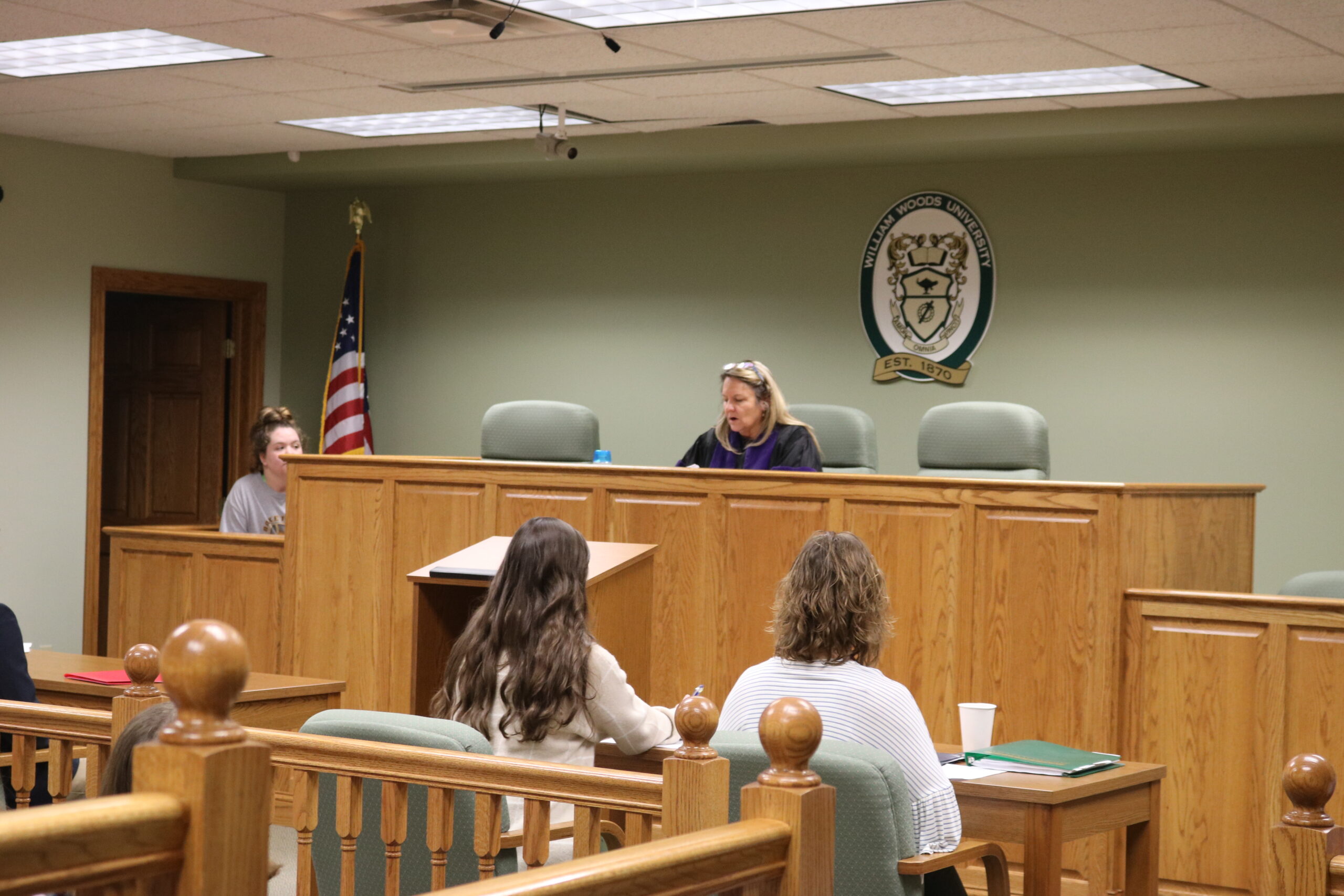
Enter the Field of Legal Support and Services:
Do all that and much more when you earn a degree in the Woods Global Legal Studies Program.
Earning this degree opens your future to a vast array of high-paying career options. The American Bar Association conducted a national employers survey and found 86% of employers said that they’ll likely hire a legal studies graduate in the next year, and 71% said they’re willing to pay a premium salary.*
Our expert faculty designed the program specifically for working adults with busy lives. Because William Woods University has been a leader in legal studies for more than 40 years, you’ll find our graduates all across the country. They go on to law school or choose from career options in law firms, state and federal government offices, non-profits, and a wide variety of corporate organizations.
The William Woods online B.S. in Paralegal Studies degree consists of 42 semester hours in a 14-course sequence. Coursework focuses on the application of substantive and procedural law to legal fact patterns that professionals would encounter in the legal environment. The program strives to build a core of legal knowledge and critical thinking skills, as well as an understanding of professional ethics, communication, and interpersonal skills. These all serve to enhance your ability to function as an effective professional in the legal environment.
Freshman applicants – for all undergraduate students
The Admissions Committee may review student qualifications and conditionally/provisionally accept students who do not met the minimum 2.5 GPA on a 4.0 scale and a minimum ACT or SAT I composite score of 19 or 890, respectively.
William Woods online undergraduate programs are available to students across the country. In Missouri, our students come from Fulton, Columbia, Jefferson City, St. Louis, Kansas City, Moberly, Springfield, Ozark, Cape Girardeau, Rolla and many more locations. Beyond Missouri, our online graduates hail from California, Illinois, Kansas, Washington, Arkansas and other states.
Legal Studies – 39 Credits
To provide students with a core of legal knowledge and critical thinking, understanding of professional ethics, communication and interpersonal skills, which will enhance the students’ ability to function effectively as professionals in a legal environment.
| An introduction to the American legal system including sources of law, the court systems and fundamental legal principles in several substantive areas of law. credits: | American Legal System -Q | 3 |
| This course takes a critical look at codes of ethics that guide the legal profession and contemporary moral and ethical problems that comprise much of the debate over current legal issues such as abortion, euthanasia, and capital punishment. These topics are examined thought the lens of various ethical theories including utilitarianism, categorical imperative, divine command theory and cultural relativism. credits: | Law, Ethics and Morality -U | 3 |
| This course explains the what, how, and why of legal research. Students will learn Boolean searching and formation of queries in order to facilitate the location of primary legal authority and secondary sources. The skills learned in this course will allow students to research paid legal databases and the Internet for substantive and procedural law and to think critically while moving through the steps to locate statutes and case law in order to assist the attorney in representing a client and their legal issue. credits: | Electronic Legal Research | 3 |
| This course introduces the process of civil practice (procedural rules) and the law that governs it (substantive law) and to the skills of investigating and fact gathering which includes interviewing of clients and witnesses. Students will gain practice in drafting the documents necessary for civil matter to proceed through the legal system from filing through trial and post-trial. credits: | Civil Practice | 3 |
| This course will provide students with a general understanding of family law practice, including dissolution, custody, property division and adoption. It will also include juvenile law practice issues including abuse and neglect. credits: | Family and Juvenile Law | 3 |
| This course will provide a basic understanding of the substantive and procedural criminal law including due process, probable cause, statutory and case law authorities governing criminal law and the rules of criminal procedure. Students will also review the structure of the criminal courts system. This course provides application of the substantive law and procedural safeguards to a case study in representing either the state or a defendant in a criminal law proceeding. credits: | Criminal Practice | 3 |
| This course presents basic concepts of administrative law and procedure in federal and state agencies. Students will learn advocacy techniques for representing a client in an administrative process. Substantive topics will include administrative delegation of power, rulemaking, agency discretionary powers, remedies, and judicial appeals. Federal law will focus on procedure in Federal courts and applicable state rules. credits: | Administrative Law | 3 |
| This course focuses on general legal principles and practice related to business and commercial law including business organizations; employment and labor; liability; and the UCC including various federal acts related to consumer protection. Drafting legal documents will be included. credits: | Business and Commercial Issues | 3 |
credits: | Special Topics: Legal Studies | 3 |
| Will provide a basic understanding of the substantive law of contracts. The course focus is on both common law and the uniform commercial code in regard to the basic elements of contract formation and will involve practical research assignments to explore the practical application of the principles of contracts. credits: | Contracts | 3 |
| This course will introduce students to the principle concepts of government that underlay the structure of the United States Constitution. These concepts include federalism and judicial review. In addition, the course will examine the Court’s methods of Constitutional interpretation. Through case study of major Supreme Court decisions, students will explore the meaning of the civil liberties contained in the first ten amendments to the constitution, also known as the Bill of Rights, including due process, equal protection, the rights of criminal defendants and the freedoms of speech, religion and privacy. Prerequisites: PLS110 credits: | Constitutional Issues | 3 |
| Tort law is the area of law that provides a remedy for harms to private individuals. Tor law includes intentional torts and unintentional torts. This course will introduce students to the theory that forms the basis for society’s interest in assigning blame and the economic distribution of liability. credits: | Torts Law | 3 |
| The capstone/practicum course is the final course in the paralegal studies program. This course will provide students with an opportunity to demonstrate proficiency as a paralegal in two ways. First, through the practicum, students will demonstrate the ability to apply coursework in an actual law office setting, similar to participating in a virtual internship. Second, students will demonstrate their proficiency in legal reasoning through the capstone research and writing assignment. credits: | Virtual Law Office Capstone | 3 |