 English
Special opportunities
There are many ways to learn the legal world, get involved and gain experience.
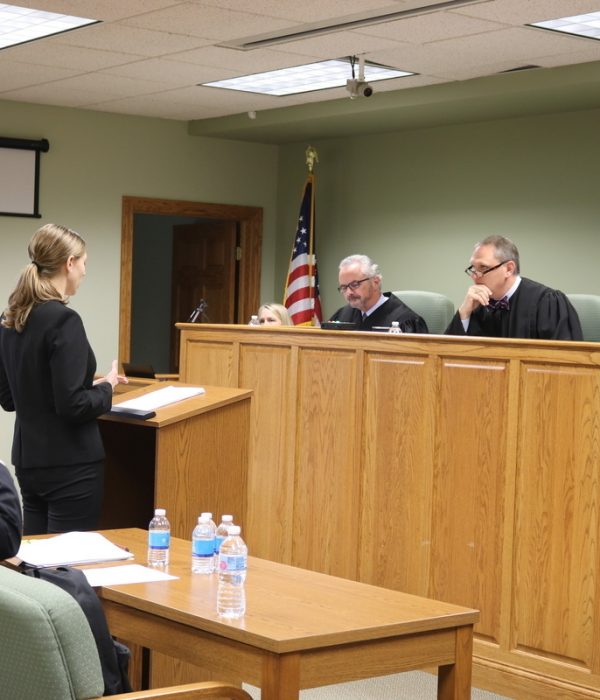
- Participate in competitive mock trial through the William Woods University American Mock Trial Team. We also have our own Model Court Room
- Join our prelaw chapter of Phi Alpha Delta, International, the largest legal fraternity in the world
- Obtain a specialized certificate in prelaw or political studies
- Engage in internships for academic credit in the legal or political fields in a variety of settings such as government agencies, law firms, or the legislative, executive and judicial branches of state or federal government
- Attend conferences related to your interests
- Conduct scholarly research in law or political science
- Take part in political and advocacy activities through public service and other events
Our Political/Legal Studies degree at work
Our alumni have found successful careers in leading agencies, companies and firms:
- Noble Biocare International
- Bell & Watson, PLLC, Memphis, TN
- Cox Health Systems
- Missouri Secretary of State
- High Caliber Stables, North Carolina
- North Star Resource Group
- Columbia Police Department
- United States Marine Corp
- General Motors
- Province of Ontario
- Pate’s Law Group, Orlando FL
- William Woods University
- Boomerang Strategies, McKinney, TX
- State of Missouri
- Spectrum Brands, Inc.
- McAdams, LTD
- DeVry Education Group, Government Relations Department
- Midwest Litigation Services
- Chelsea Meadows Equestrian Center
- Veteran’s United Home Loans
- Missouri Division of Youth Services
- New Bloomfield Schools
- United States Senate, Office of the Press Secretary for the Environment and Public Works Committee
- Legislative Lobbyist firm for the KC Chiefs and others
- Central Trust & Investment Company
- OHELA
- Boone County Circuit Clerk
- Florida GAL Foundation
- Dinsmoer & Shohl, Commercial Litigation, Kentucky
- Prosecuting Attorney office, Lincoln County and others
- Kathy J. Weinman Children’s Advocacy Center, St. Louis, MO
- Scholastic
Some graduate and law schools attended by political/legal studies and criminal justice grads:
- University of Missouri Law School
- University of Missouri Master’s and Doctorate program in Political Science
- University of Missouri Master’s in Education
- Oklahoma City Law School
- St. Louis University Law School
- American University Law School, Washington, DC
- University of Missouri-Kansas City Law School
- University of Missouri-Kansas City Master’s program in Political Science
- Barry University Law School – Florida
- William Mitchell College of Law
- Master’s of Liberal Arts in Journalism, Harvard
- University of Denver Law School
I am always proud of this program when I learn students have been accepted to law or graduate school; have been selected for awards through their professional work after leaving WWU; or send me an email telling me how much our program has helped them in their personal and professional lives.— Cynthia Kramer, Professor of Legal Studies
I have attended three higher education institutions and I can honestly say that I think a young person looking to go to college would be hard pressed to find a better school academically than William Woods. WWU has the small community feeling, where members of the administration and faculty care about your overall success.— Adam Patchett, political/legal studies graduate and Oklahoma City University School of Law graduate, now an attorney at Powell, Bush & Patchett, L.L.C. in Columbia, Mo.
The Bachelor of Arts in Political/Legal Studies degree at William Woods University consists of 122 distinct credit hours for graduation—including 18 core major credits, 18 required elective credits, a minor, and a year of a foreign language.
Major Requirements
Core Credits: 39.00
|
An introduction to the American legal system including sources of law, the court systems and fundamental legal principles in several substantive areas of law. credits:
|
American Legal System -Q | 3 |
|
This course takes a critical look at codes of ethics that guide the legal profession and contemporary moral and ethical problems that comprise much of the debate over current legal issues such as abortion, euthanasia, and capital punishment. These topics are examined thought the lens of various ethical theories including utilitarianism, categorical imperative, divine command theory and cultural relativism. credits:
|
Law, Ethics and Morality -U | 3 |
|
This course explains the what, how, and why of legal research. Students will learn Boolean searching and formation of queries in order to facilitate the location of primary legal authority and secondary sources. The skills learned in this course will allow students to research paid legal databases and the Internet for substantive and procedural law and to think critically while moving through the steps to locate statutes and case law in order to assist the attorney in representing a client and their legal issue. credits:
|
Electronic Legal Research | 3 |
|
This course introduces the process of civil practice (procedural rules) and the law that governs it (substantive law) and to the skills of investigating and fact gathering which includes interviewing of clients and witnesses. Students will gain practice in drafting the documents necessary for civil matter to proceed through the legal system from filing through trial and post-trial. credits:
|
Civil Practice | 3 |
|
This course will provide students with a general understanding of family law practice, including dissolution, custody, property division and adoption. It will also include juvenile law practice issues including abuse and neglect. credits:
|
Family and Juvenile Law | 3 |
|
This course will provide a basic understanding of the substantive and procedural criminal law including due process, probable cause, statutory and case law authorities governing criminal law and the rules of criminal procedure. Students will also review the structure of the criminal courts system. This course provides application of the substantive law and procedural safeguards to a case study in representing either the state or a defendant in a criminal law proceeding. credits:
|
Criminal Practice | 3 |
|
This course presents basic concepts of administrative law and procedure in federal and state agencies. Students will learn advocacy techniques for representing a client in an administrative process. Substantive topics will include administrative delegation of power, rulemaking, agency discretionary powers, remedies, and judicial appeals. Federal law will focus on procedure in Federal courts and applicable state rules. credits:
|
Administrative Law | 3 |
|
This course focuses on general legal principles and practice related to business and commercial law including business organizations; employment and labor; liability; and the UCC including various federal acts related to consumer protection. Drafting legal documents will be included. credits:
|
Business and Commercial Issues | 3 |
credits:
|
Special Topics: Legal Studies | 3 |
|
Will provide a basic understanding of the substantive law of contracts. The course focus is on both common law and the uniform commercial code in regard to the basic elements of contract formation and will involve practical research assignments to explore the practical application of the principles of contracts. credits:
|
Contracts | 3 |
|
This course will introduce students to the principle concepts of government that underlay the structure of the United States Constitution. These concepts include federalism and judicial review. In addition, the course will examine the Court’s methods of Constitutional interpretation. Through case study of major Supreme Court decisions, students will explore the meaning of the civil liberties contained in the first ten amendments to the constitution, also known as the Bill of Rights, including due process, equal protection, the rights of criminal defendants and the freedoms of speech, religion and privacy. Prerequisites: PLS110 credits:
|
Constitutional Issues | 3 |
|
Tort law is the area of law that provides a remedy for harms to private individuals. Tor law includes intentional torts and unintentional torts. This course will introduce students to the theory that forms the basis for society’s interest in assigning blame and the economic distribution of liability. credits:
|
Torts Law | 3 |
|
The capstone/practicum course is the final course in the paralegal studies program. This course will provide students with an opportunity to demonstrate proficiency as a paralegal in two ways. First, through the practicum, students will demonstrate the ability to apply coursework in an actual law office setting, similar to participating in a virtual internship. Second, students will demonstrate their proficiency in legal reasoning through the capstone research and writing assignment. credits:
|
Virtual Law Office Capstone | 3 |